
A box of cards
Determining the provenance of a bicycle begins with the evidence it wears. Head badge…decals…frame numbers…components…wear and tear. RIH hand made bikes for 91 years. Fongers and Cove made replicas for a combined 31 years.
Unsurprisingly, other than the bicycles themselves, the physical records of most small bicycle companies no longer exist. Annual production records, models and sizes offered, sales prices, installed components—all would help identify a bike.
Large manufacturer’s frame number systems are usually known. Others used non-chronological, arcane numbering understood only to them. Most bicycle frame builders stamped their work with a serial or frame number.
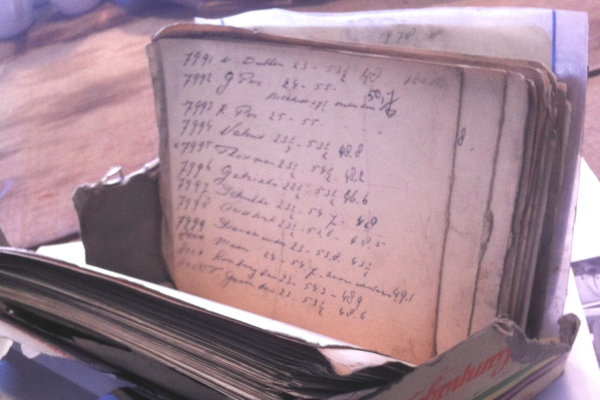
For the two-man RIH shop most business information was naturally carried around in their heads, just like their frame building knowledge. Fortunately, there are handwritten monthly production figures noted on index cards dating from Wim Jr.’s time in the mid-1950s. They help place the RIH business enterprise in context. It was a small business.
Tubes and badges
RIH’s 91-year history covered here focuses on the three generations at the Westerstraat shop. It also touches on RIH production at Fongers in Groningen and Cové in Venlo.
From what can be gleaned from the internet, the decal transfers on the sides of RIH downtubes mostly read RIH-SPORT or RIH. Most RIHs also have transfers on the downtube facing the rider. These have been variously spotted reading BUSTRAAN AMSTERDAM, ADAM BUSTRAAN, BUSTRAAN ADAM, BUSTRAAN HOLLAND, and VENLO HOLLAND (the last two are from RIH-Cové). Some simply read AMSTERDAM. Its not clear when Bustraan started putting his name on the downtubes.
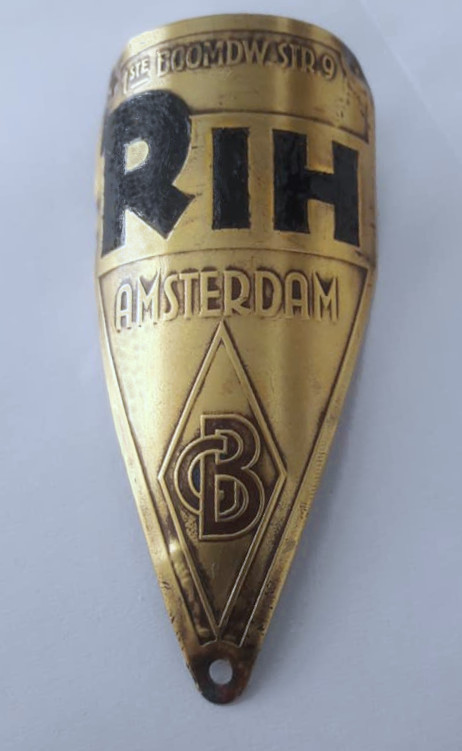
Head badges also varied over time. The earliest featured the Boomwaardstraat address and the interwoven GB monogram. GB represents Gebroeders Bustraan, the Bustraan Brothers.
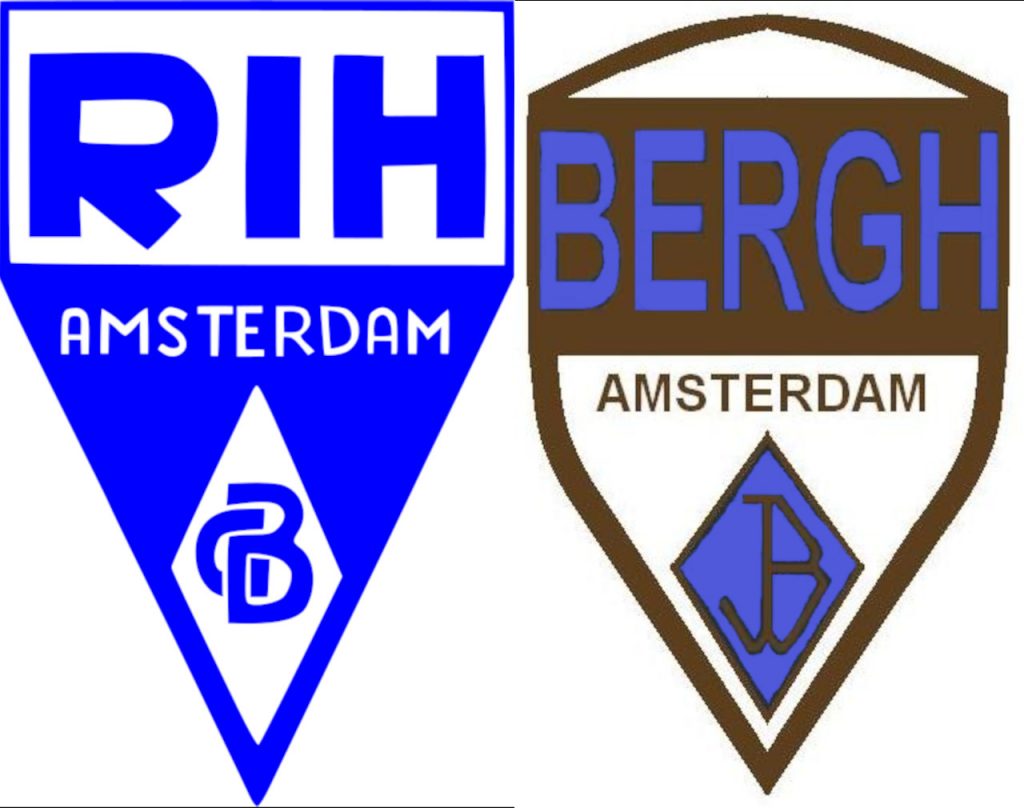
A graphic artist named van Klinkum created the RIH head badge. His artistry was in demand by Dutch frame builders. He designed transfers and head badges for Dutch brands Germi, Jabo, Joco, Stephi Sport, Bergh, and others. For instance, the RIH and Bergh head badge designs were similar. It is said Amsterdam frame builder Jaap van den Bergh was a billiard-playing colleague of both Bustraan and van der Kaaij.
Framenummers
RIH was a two-man business crafting made-to-order bicycles for individual customers. Each bicycle carried a unique identification number stamped into its frame. The RIH Sport Amsterdam website provides valuable serial frame number card data covering 26 years from 1956 to 1982.
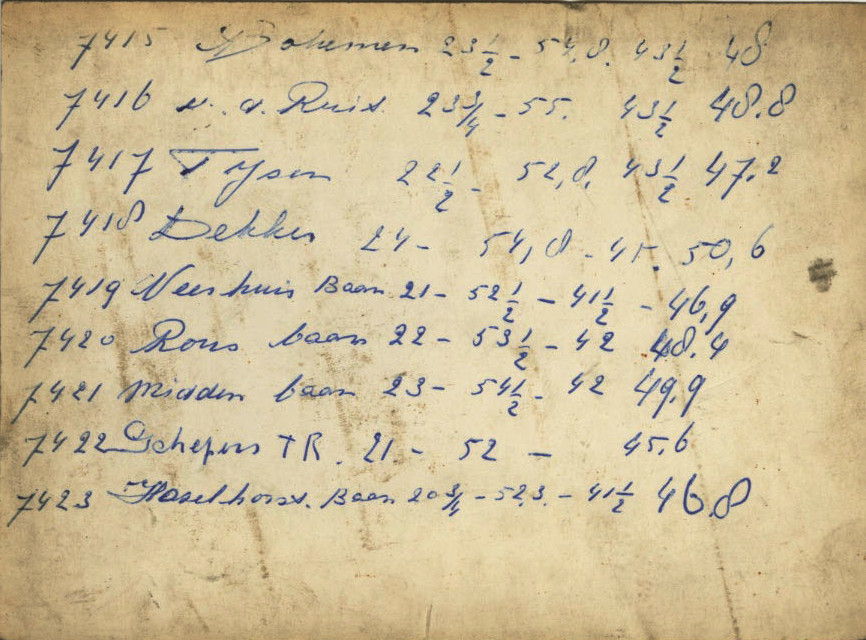
Upon examination the cards appear to be production records kept by Wim Bustraan Jr. He assumed ownership following his father’s 1955 death. They all have the same handwriting. There is a dramatic production decline once the business passed to van der Kaaij.
Given his public statements and business and legal machinations, Wim was clearly anxious to boost output. He would not have let production fall after RIH was his. Thus, it is assumed van der Kaaij kept his personal production records separate from Bustraan’s records.
The cards include the frame number, frame dimensions, and the buyer. Very few cards carry a date and year, but the cards were kept monthly, so some date estimating is possible. RIH Sport Amsterdam has generously included those estimates on their website. Also, not all sales receipts will match the record cards. The date the frame was finished and the date the owner could get to the Westerstraat shop to pay for it could be different.
The whereabouts of the earlier production records from the Willem and Joop period (1921 to 1955) are unknown to the author. The records of many of small frame builders no longer exist; the earlier RIH records may have similarly vanished. Further, the location of Wim van der Kaaij’s frame numbering records is unknown to the author.
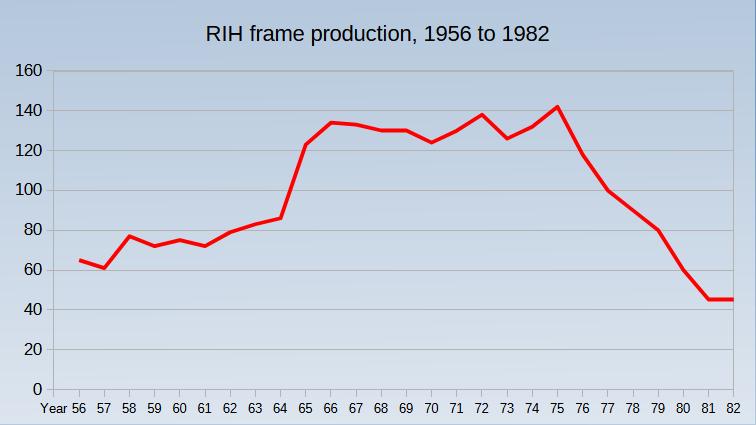
The records cards reveal…
- 2,650 frames built over 26 years
- That’s an average of 102 bikes per year or two bikes a week
- A gradual production increase followed by a doubling of output between 1964 and 1966
- Van der Kaaij surely played a large part in the jump
- Two years after Wim van der Kaaij assumed ownership, annual production peaked at 142 frames
- Thereafter, production dropped off considerably
- Forty-five frames were made in 1982, the year before Wim Jr passed away
The author prefers to believe the post-1973 pattern reflects the output of a 58-year old gentleman who liked to fish and was easing into retirement.
Frame numbering systems
There are at least four frame numbering systems found on RIHs.
RIH Fongers (Groningen) These RIHs used Fongers’ frame numbering system. Three to five digits and a letter. The letters identified the year of manufacture. The series ran as follows: 1961 (M), 1962 (U), 1963 (B), 1964 (X), 1965 (A), 1966 (Z), 1967 (K), 1968 (H), 1969 (T), and 1970 (A). The serial number is found on the head tube.
RIH Cové (Venlo) The frame numbers are five digits and are found on the bottom bracket. The first two digits are the year of manufacture and the last three are presumably serial order of manufacture (e.g., the 391st of the production year).
RIH Sport and RIH Sport Amsterdam: The frame numbers are on the head tube.
Covering the 1955 to 1982 period, the system was simply consecutive or serial numbers. They were hand-recorded by Wim Jr. on monthly cards. Reflecting a tremendous effort by Ab Winsemius, the RIH Sport Amsterdam website provides an image of each card.
A conjecture is that prior to 1955 Willem used the same sequential frame numbering system that his son Wim Jr continued when he began recording frame number is 1955.
Sometime after he assumed ownership Wim van der Kaaij began using a different numbering system. The frames were assigned a five digit number: the year (the first two numbers) and a sequential number (beginning with 001). Among the records cards are just two of van der Kaaij’s: frames 82001 through 82022.
As an expression of Wim’s aspirations, at some point the digits for the sequential number expanded to four (from YY-NNN to YY-NNNN).
Radsport RIH (Vienna). The book Wiener Mechanikerräder 1930-1980: Eine Rundfahrt durch mehr als 100 Wiener Fahrradmarken has the formula for decoding their eight-symbol frame numbering system. It supposedly involves a punctuation mark, single digits representing frame type and frame sizes, and the subtraction of the number eleven. The book is in German. Viel Glück.